
An Approaching Crisis
11 May 2026
The fifth chart in Caroline Johnson’s and Nick Manning’s opening presentation at last October’s Advertising: Who Cares? Summit contained four words.
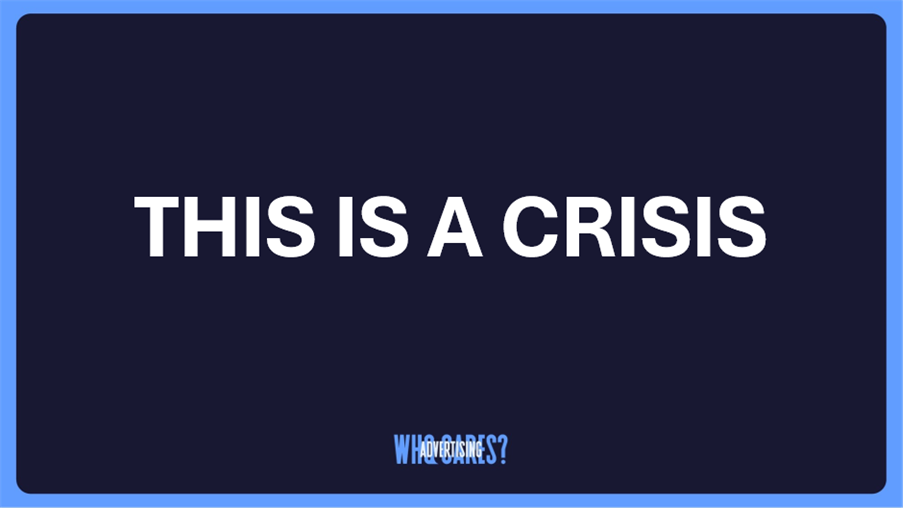
As Nick and Caroline said (in their fourth chart) “50% of global ad spend goes to 5 companies”.
Things have not exactly improved since October.
Press Gazette’s analysis, published on April 30th has Google, META and Amazon accounting for 66.3% of UK adspend.
Whilst our ultimate trade body, The Advertising Association, was celebrating its 100th birthday last week with the cheery news that UK adspend had grown by 6.5% 2025 over 2024, the less cheery news, that TV was down 1.2%, national newsbrands down by 4.6%, regional newsbrands down 6% and magazines down 5.1% received less attention.
It is far too easy to shrug and suggest that the world changes, advertising changes with it and if that means an ad market controlled by three players, well that’s capitalism in action.
But it’s not quite as straightforward as that.
The UK creative services industry has been remarkably successful. Here’s a few more numbers.
The creative economy (including advertising) contributes over £124 billion in gross value added to the economy. Over recent years it’s been growing at between three and four times the national average. In 2024 the sector employed approximately 2.4 million people. As a proportion of the total UK economy the creative industries contributed roughly 5% to 6% of total UK economic output.
Today, two-thirds of UK adspend going to a few giants means we put our home creative industries at risk. The more money flows towards the platforms the more we underfund our own media channels which in turn is negative on the economy and jobs
A few of us remember when UK advertising was the envy of the ad world; when we made TV dramas and comedies that travelled; when our news gathering was trusted.
Today we fund platforms that harm children.
Can you imagine a TV programme that incites violence and yet has somehow managed to sidestep the regulations and get on air? Would advertisers be happy with their ads appearing in such content? Of course they wouldn’t. And yet, put the content online and somehow that makes it alright.
The dual standards, the hypocrisy is remarkable.
This has nothing to do with having a whack at the online platforms, rather it’s making the case for a level playing field, for common definitions, for regulations that control content excesses.
Our trade bodies talk of advertising being legal, decent, honest and truthful. And yet they stay remarkably quiet when some of their vendor members behave illegally (running fake ads), indecently (undressing apps), dishonestly (designing addictive algorithms then denying having done so) and deceitfully (inflating ad metrics).
On June 11th Advertising: Who Cares? is holding a three hour mini event, Who Cares Wins at the central London offices of Prospect Magazine.
We will start by reviewing the research into the effectiveness of advertising within different channels (Who Cares About the Facts).
We will host two long-form moderated discussions: Who Cares About Content; and Who Cares About Safety.
Our speakers will not be the ‘usual suspects’. Our discussions will not be yet another couple of panels where everyone agrees.
We will feature publishers, editors, regulators, activists, programme makers. Speaker details will be on our site.
We will invite contributions from the floor.
We are inviting policy makers, politicians to attend.
As with all AWC events this one will not be sponsored; there will be open discussion, without fear or favour.
As Nick and Caroline said, this is a crisis.
We want to try to do something about it. We should do something about it. Lay out the facts, have the discussion.
Do come along to listen, and to have your say. Tickets are here.